
Every Sustainable City Begins with One Simple Habit
Imagine throwing your leftover food, plastic bottle, tissue paper, batteries, and glass into a single dustbin.
Now imagine asking someone to separate everything later.
Almost impossible.
This is exactly why many waste management systems struggle—not because of a lack of technology, but because waste is mixed at the source.
Source segregation is the single most important step in creating a cleaner, healthier, and more sustainable future. Whether you are a homeowner, apartment resident, corporate office, hotel, hospital, or municipality, segregating waste before disposal dramatically improves recycling efficiency, reduces pollution, and creates valuable resources from what was once considered garbage.
At Kenterra, we believe that effective waste management starts long before waste reaches a processing facility—it starts with the choices we make every day.
What is Source Segregation?
Source segregation simply means separating waste where it is generated instead of mixing everything together.
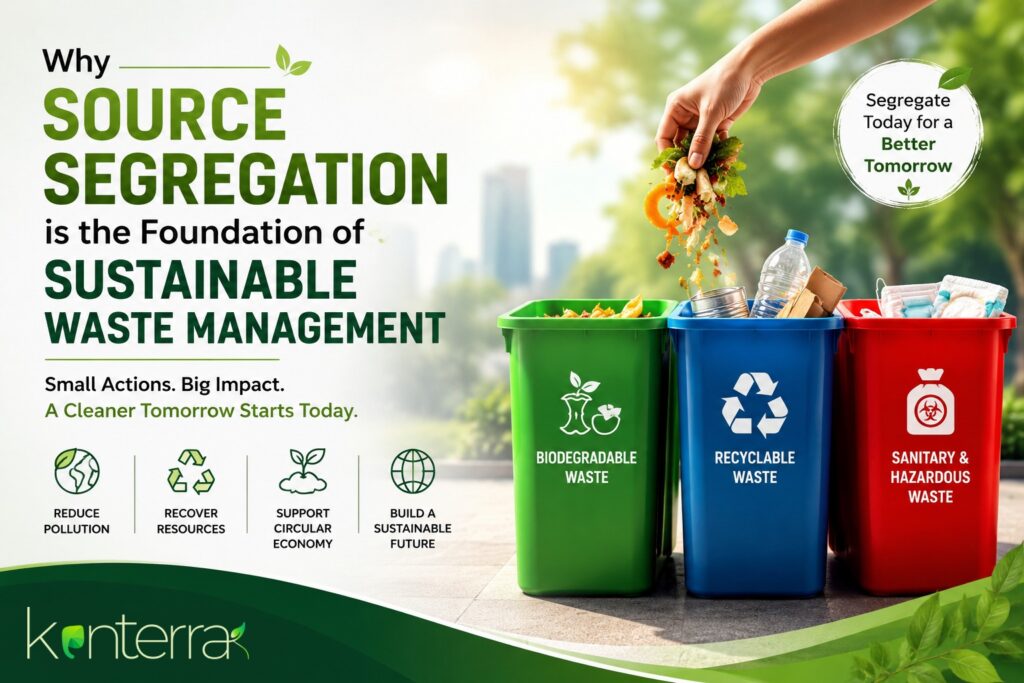
A simple three-bin system is enough for most households and businesses:
🟢 Biodegradable Waste
- Vegetable peels
- Fruit waste
- Leftover food
- Garden waste
- Coffee grounds
- Tea leaves
🔵 Recyclable Waste
- Paper
- Cardboard
- Plastic bottles
- Metal cans
- Glass
🔴 Sanitary & Hazardous Waste
- Sanitary pads
- Diapers
- Medical waste
- Batteries
- Bulbs
- Electronic waste
When these waste streams remain separated, each one can be processed using the most appropriate technology.
What Happens When Waste is Mixed?
Mixed waste creates multiple environmental problems.
Organic Waste Contaminates Recyclables
Food residue on paper or plastic makes recycling difficult and expensive.
Increased Landfill Waste
Materials that could have been recycled often end up buried in landfills.
Odour and Pest Problems
Mixed biodegradable waste rapidly decomposes, producing:
- Bad smell
- Leachate
- Flies
- Maggots
- Rodents
Higher Processing Costs
Waste sorting becomes labour-intensive and less efficient.
The result?
Communities spend more money while recovering fewer resources.
The Environmental Benefits of Source Segregation
Proper segregation creates a chain reaction of positive environmental outcomes.
Less Waste in Landfills
Organic waste can be composted instead of dumped.
Better Recycling Rates
Clean recyclable materials retain higher market value.
Reduced Greenhouse Gas Emissions
Organic waste processed through composting produces far fewer methane emissions than waste buried in landfills.
Cleaner Cities
Less overflowing waste means healthier public spaces.
Better Soil Health
Organic waste becomes compost instead of pollution.
Waste is a Valuable Resource
One banana peel may seem insignificant.
But when thousands of households segregate their waste, cities recover enormous quantities of organic material every day.
This material can become:
- Compost
- Liquid organic fertilizer
- Soil-less planting media
- Biogas
- Organic soil conditioners
Instead of creating pollution, it creates value.
Apartment Communities Can Lead the Change
Apartment complexes generate hundreds of kilograms of organic waste every day.
With proper segregation, residential communities can:
- Process waste at source
- Produce compost for landscaping
- Reduce waste collection costs
- Eliminate foul odours
- Improve hygiene
- Support circular waste management
Communities that segregate waste also experience cleaner waste collection areas and lower maintenance costs.
Businesses Have an Important Role
Commercial establishments generate significant quantities of food and packaging waste.
Hotels, restaurants, shopping malls, hospitals, educational institutions, and offices can all benefit from segregation.
The advantages include:
- Reduced waste disposal expenses
- Easier regulatory compliance
- Improved ESG performance
- Better sustainability reporting
- Stronger corporate reputation
Waste management is increasingly becoming part of responsible business operations.
Source Segregation Supports a Circular Economy
In a circular economy, waste never truly becomes waste.
Instead:
Kitchen waste becomes compost.
Compost supports agriculture.
Agriculture produces food.
Food returns to our homes.
The cycle continues.
This regenerative approach reduces dependence on natural resources while minimizing environmental damage.
Technology Works Best When Waste is Segregated
Modern waste management technologies perform significantly better when organic waste is clean and uncontaminated.
Scientific composting systems, organic dewatering units, biological inoculums, liquid fertilizer production, and food waste dehydration technologies all rely on properly segregated biodegradable waste to achieve maximum efficiency.
Good technology starts with good waste.
Small Actions Create Big Impact
Many people believe environmental protection requires massive investments.
In reality, one of the biggest environmental contributions anyone can make is separating waste correctly.
Every segregated dustbin helps:
- Protect natural resources
- Reduce pollution
- Improve recycling
- Lower carbon emissions
- Create healthier communities
Sustainability begins with everyday habits.
Building Zero-Waste Communities
Zero-waste communities are not created by advanced machinery alone.
They are built through:
- Community awareness
- Responsible consumption
- Source segregation
- Scientific processing
- Resource recovery
- Continuous education
When residents, businesses, and municipalities work together, waste transforms from an environmental challenge into an opportunity for innovation and sustainability.
The Road Ahead
India’s cities are growing rapidly, bringing both opportunities and challenges. Effective waste management will depend on how well communities embrace source segregation and decentralized processing.
At Kenterra, we believe that the future of waste management lies in preventing waste from becoming pollution. By encouraging segregation at the source, recovering valuable resources, and supporting circular economy practices, we can create cleaner neighborhoods, healthier ecosystems, and more sustainable cities.
The journey toward a zero-waste future begins with a simple decision—placing waste in the right bin.
About Kenterra
Kenterra provides innovative, end-to-end sustainable waste management solutions for residential communities, commercial establishments, industries, institutions, and municipalities. From biodegradable waste processing and composting systems to resource recovery, liquid fertilizers, soil-less planting media, and decentralized waste management technologies, Kenterra helps organizations transform waste into value while supporting a cleaner and more sustainable future.
Learn more: https://staging.kenterra.in