
India generates millions of tonnes of biodegradable waste every year, much of which ends up in landfills, creating leachate, greenhouse gas emissions, foul odours, and public health concerns. While waste is often viewed as an environmental burden, Kenterra believes it is one of the country’s most valuable untapped resources.
Operating under Pelican Kenterra Private Limited, Kenterra has built an integrated ecosystem that combines scientific research, innovative engineering, biotechnology, and circular economy principles to transform waste into valuable products. Rather than simply disposing of waste, the company focuses on extracting value from every stage of the waste stream—from food waste and garden waste to compost, liquid fertilizers, soil-less planting media, and even animal feed. The company describes itself as one of India’s first organizations to develop and patent composting inoculums while providing comprehensive end-to-end waste management solutions.
From Waste Disposal to Waste Valorization
Traditional waste management generally follows a linear approach:
Collect → Transport → Dump
Kenterra replaces this with a circular model:
Segregate → Process → Recover → Reuse → Regenerate
Every biodegradable material is treated as a valuable resource capable of becoming compost, fertilizer, renewable biomass, landscaping material, or other useful products.
Their mission is straightforward:
Add value to waste so that waste management becomes a source of environmental and economic value rather than a recurring expense.
Solving India’s Organic Waste Challenge
Biodegradable waste presents several recurring challenges:
- Leachate generation
- Offensive odour
- Maggot infestation
- Slow composting
- High moisture content
- Excess compost accumulation
- Rising landfill dependency
Kenterra has developed an integrated technology platform that addresses these issues through mechanical processing, biological treatment, scientific composting, and resource recovery.
Integrated Waste Management Solutions
Organic Dewatering Unit (ODU)
The Organic Dewatering Unit is designed to significantly reduce the moisture content of organic waste before composting.
Its advantages include:
- Reduced leachate formation
- Odour control
- Prevention of maggot infestation
- Faster composting cycles
- Lower requirement for bulking materials such as cocopeat or sawdust
- Higher-quality compost output
Removing excess moisture before biological processing greatly improves composting efficiency while reducing operational costs.
Liquid Fertilizer Fermenter
Instead of discarding the liquid separated during dewatering, Kenterra converts it into a useful agricultural resource.
The fermentation system produces:
- Liquid organic fertilizer
- Biogas as a secondary by-product
- Zero-discharge processing systems
This helps convert waste streams into economically useful products while minimizing environmental impact.
BYOBIN Bulk Composting System
Kenterra’s BYOBIN composting units are designed for:
- Apartment complexes
- Gated communities
- Educational institutions
- Hotels
- Commercial establishments
- Corporate campuses
The systems feature:
- Aerobic composting
- Low maintenance
- Compact footprint
- Reduced insect infestation
- Lower operating costs
- Efficient conversion of organic waste into compost
COMPOSORB Composting Inoculum
One of Kenterra’s flagship innovations is COMPOSORB, a patented composting inoculum designed to improve aerobic composting.
According to the company, COMPOSORB:
- Accelerates biodegradation
- Reduces foul odour
- Produces nutrient-rich compost
- Helps create soil-less planting media
- Can be used for kitchen waste, fish waste, meat waste, vegetable market waste, poultry waste, and other biodegradable materials.
MuMaH: Microwave-Based Food Waste Dehydration Technology
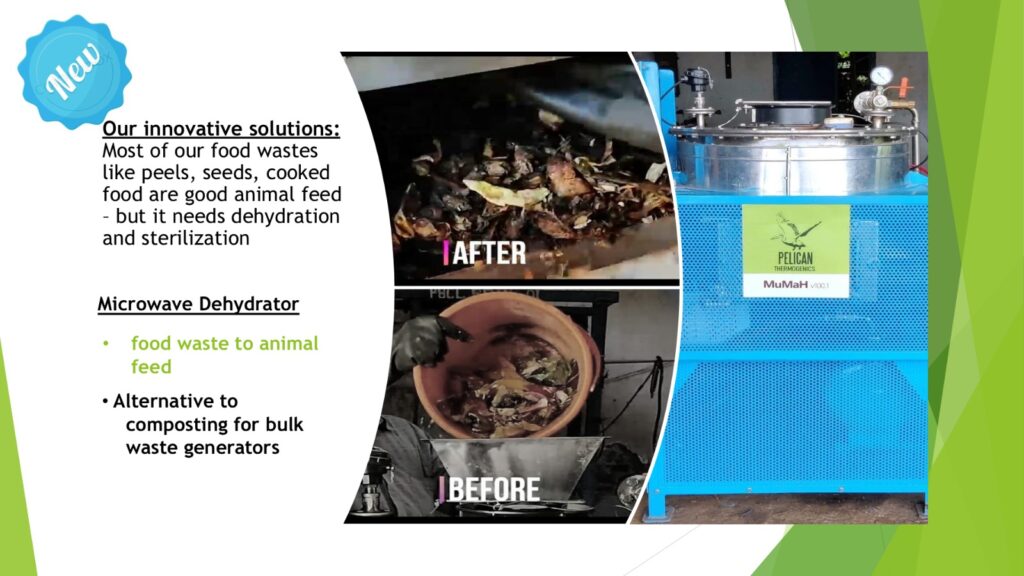
Among Kenterra’s newest innovations is MuMaH, a microwave-based food waste dehydration system designed for rapid and hygienic processing of food waste.
Unlike conventional composting, MuMaH focuses on dehydration and sterilization, converting food waste into a stable raw material suitable for further processing, including animal feed applications where appropriate processing standards are met.
The presentation highlights several advantages:
- Rapid dehydration
- Enhanced heating efficiency
- Microwave-based sterilization
- Minimal nutritional loss
- Plug-and-play operation
- Solar compatibility
- Modular and scalable architecture
This technology provides an alternative to conventional composting for specific bulk food waste generators by reducing moisture rapidly and minimizing storage-related odour and contamination.
Food Waste to Animal Feed
One of the emerging innovations showcased by Kenterra is the conversion of selected food waste streams into processed animal feed ingredients.
Food waste such as:
- Vegetable peels
- Fruit waste
- Cooked food residues
- Seeds
can potentially be converted into animal feed after dehydration and sterilization using microwave processing.
This approach supports:
- Waste reduction
- Circular resource utilization
- Reduced dependence on landfill disposal
- Increased recovery of food value
Scientific Compost Products
Instead of producing ordinary compost, Kenterra focuses on developing engineered organic products.
Its processed outputs include:
Soil-less Planting Media
Suitable for:
- Nurseries
- Terrace gardens
- Organic farms
- Urban landscaping
- Road medians
Liquid Organic Fertilizer
Containing naturally occurring nutrients including:
- Nitrogen
- Phosphorus
- Potassium
- Micronutrients
These products extend the value chain beyond waste processing into agriculture and horticulture.
Compost to Soil-less Metro Gardening
One of Kenterra’s most distinctive initiatives is the conversion of compost into soil-less planting media for urban infrastructure.
The concept enables:
- Metro corridors
- Road medians
- Urban landscaping
- Public green infrastructure
to use compost-derived engineered growing media instead of mined topsoil.
Benefits include:
- Reduced soil extraction
- Productive use of compost
- Carbon reduction
- Urban greening
- Sustainable public landscaping
The company has showcased examples of landscaped metro medians using compost-based planting systems as part of its “Zero Carbon Road Median” initiative.
Zero Carbon Metro Services
Kenterra also proposes comprehensive waste management services for residential communities and institutional campuses.
These integrated services include:
- Door-to-door waste collection
- Composting at source
- Garden waste management
- Tree pruning waste processing
- Recycling of non-biodegradable waste
- Sanitary waste management
- Equipment installation and maintenance
This service model enables apartment complexes and gated communities to implement decentralized waste management systems.
Waste Solutions for Apartments and Communities
Apartment complexes generate significant quantities of biodegradable waste every day.
Kenterra provides complete community solutions including:
- Household compost bins
- Bulk composting systems
- COMPOSORB inoculum
- Collection services
- Waste segregation training
- Compost utilization
- Recycling support
This integrated model helps communities reduce landfill dependence while generating compost for landscaping and gardening.
Municipal and Smart City Applications
The presentation demonstrates that Kenterra’s technologies are designed not only for residential communities but also for municipal-scale projects.
Applications include:
- Municipal biodegradable waste processing
- Market waste management
- Garden waste recycling
- Food processing waste
- Fish market waste
- Slaughterhouse waste
- Legacy waste recovery
- Public infrastructure landscaping
One concept presented includes rotary drum segregation for processing legacy biodegradable waste, enabling material separation and further resource recovery.
Green Protocol and Sustainable Events
Kenterra also promotes Green Protocol initiatives aimed at reducing waste generation during public events.
The approach emphasizes:
- Source segregation
- Reduction of disposable materials
- Reusable service ware
- Volunteer participation
- Responsible event waste management
These initiatives demonstrate that sustainability begins with behavioural change in addition to technological innovation.
Vertical Gardens and Circular Landscaping
Another innovation highlighted is the development of zero-carbon vertical gardens.
These systems utilize:
- Compost
- Coir geotextiles
- Coir fibre
- Natural growing media
instead of conventional plastic or metal structures, creating environmentally friendly urban greening solutions.
Applications Across Multiple Industries
Kenterra’s technologies can be applied across a broad spectrum of sectors:
Residential
- Individual homes
- Villas
- Apartments
- Gated communities
Commercial
- Hotels
- Restaurants
- Food courts
- Shopping malls
- Corporate campuses
Industrial
- Food processing industries
- Fish processing
- Meat processing
- Fruit and vegetable industries
Public Infrastructure
- Metro rail systems
- Municipal corporations
- Smart cities
- Government institutions
- Educational campuses
Agriculture
- Organic farming
- Nurseries
- Terrace gardens
- Landscape maintenance
Environmental Impact
Kenterra’s integrated approach contributes to multiple sustainability objectives:
- Reduction of landfill waste
- Lower greenhouse gas emissions
- Prevention of leachate pollution
- Reduced odour generation
- Improved source segregation
- Compost recovery
- Resource circularity
- Urban greening
- Sustainable landscaping
- Carbon footprint reduction
The company also aligns its work with broader Environmental, Social, and Governance (ESG) goals and several United Nations Sustainable Development Goals (SDGs), particularly those related to sustainable cities, climate action, and responsible resource management.
Research-Driven Innovation
Kenterra places strong emphasis on research and product development.
Its innovation portfolio now spans:
- Composting inoculums
- Organic dewatering technology
- Bulk composting systems
- Liquid fertilizer production
- Microwave dehydration technology (MuMaH)
- Soil-less planting media
- Compost-based urban landscaping
- Vertical garden systems
- Integrated waste management services
This demonstrates an evolution from conventional composting toward comprehensive circular bioeconomy solutions.
A Vision for Circular Cities
Urban India is rapidly moving toward decentralized, technology-enabled waste management. Kenterra’s integrated model illustrates how cities can transition from waste disposal to resource recovery by combining engineering, biotechnology, decentralized processing, and sustainable product development.
From apartment complexes and commercial kitchens to metro corridors, municipal projects, and smart cities, Kenterra’s solutions aim to convert biodegradable waste into valuable resources such as compost, liquid fertilizer, engineered planting media, and processed biomass. Rather than treating waste as an unavoidable burden, the company’s approach positions it as a renewable resource capable of supporting cleaner cities, healthier ecosystems, and a more sustainable circular economy.