
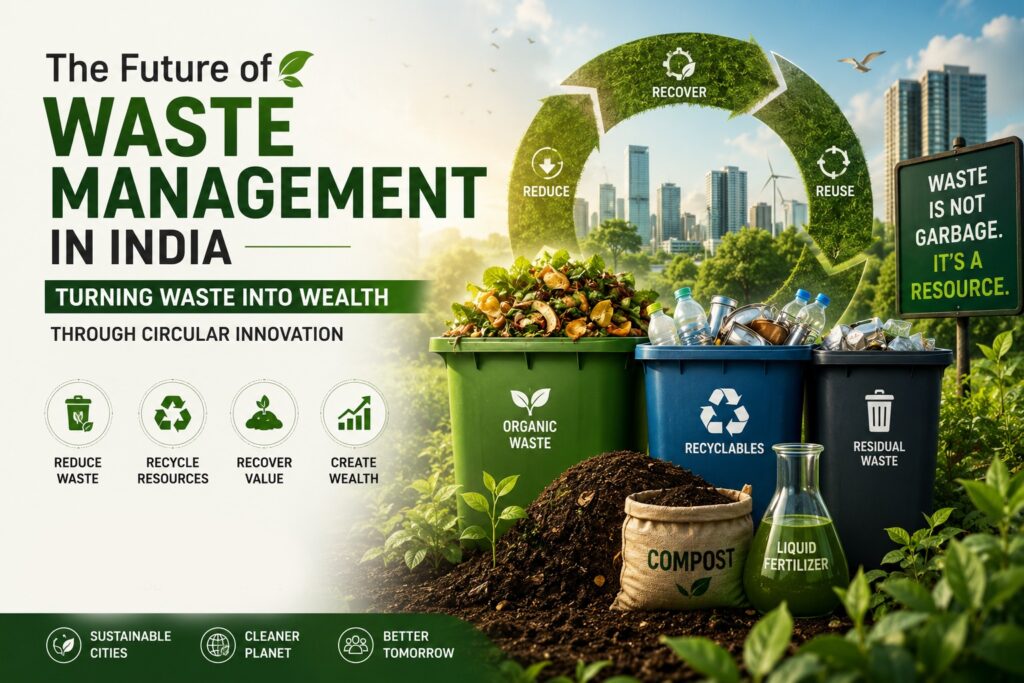
Waste is Not the Problem—How We Manage It Is.
India generates over 160,000 tonnes of municipal solid waste every day, and this number continues to rise with rapid urbanization, population growth, and changing lifestyles. While biodegradable waste accounts for nearly 50–60% of municipal waste, a significant portion still ends up in overflowing landfills, producing greenhouse gases, leachate, unpleasant odours, and public health risks.
But what if waste wasn’t considered garbage?
What if every banana peel, leftover meal, garden clipping, or vegetable waste could become a valuable resource?
This is the philosophy driving Kenterra—a company dedicated to transforming waste into wealth through innovative, science-backed, and sustainable waste management solutions.
Understanding the Circular Economy
For decades, waste management followed a simple pattern:
Take → Use → Dispose
This linear model consumes natural resources while creating enormous amounts of waste.
The future belongs to the Circular Economy, where materials are continuously reused, recycled, and regenerated.
Instead of disposing organic waste, it becomes:
- Organic compost
- Liquid fertilizer
- Soil-less planting media
- Renewable biomass
- Biogas
- Landscaping material
- Potential animal feed ingredients through appropriate processing technologies
Every kilogram of biodegradable waste diverted from landfills contributes to cleaner cities and a healthier planet.
Why Organic Waste Needs Better Management
Improper management of biodegradable waste creates several environmental challenges.
Leachate Pollution
Organic waste releases contaminated liquid known as leachate, which can seep into groundwater and pollute surrounding ecosystems.
Greenhouse Gas Emissions
When food waste decomposes anaerobically in landfills, it generates methane—a greenhouse gas significantly more potent than carbon dioxide.
Odour and Public Health
Poorly managed waste causes:
- Bad smells
- Fly breeding
- Maggot infestation
- Disease vectors
- Community complaints
Loss of Valuable Resources
Organic waste contains nutrients that could otherwise be returned to agriculture instead of being buried in landfills.
Waste is a Resource Waiting to be Recovered
The largest misconception in waste management is that waste has no value.
Organic waste contains:
- Carbon
- Nitrogen
- Potassium
- Phosphorus
- Organic matter
- Moisture
- Biological nutrients
With proper processing, these become valuable products that support agriculture, landscaping, horticulture, and urban greening.
This resource recovery approach is central to Kenterra’s integrated waste management philosophy.
Decentralized Waste Management is the Future
Transporting waste hundreds of kilometres to landfills is expensive, environmentally damaging, and increasingly unsustainable.
Instead, cities are moving toward decentralized waste management, where waste is processed close to where it is generated.
Benefits include:
- Lower transportation costs
- Reduced carbon emissions
- Faster waste processing
- Better source segregation
- Community participation
- Higher recycling efficiency
Apartment complexes, commercial establishments, educational institutions, hotels, hospitals, and corporate campuses can all process biodegradable waste at the source.
Technology is Changing Waste Management
Modern waste management is no longer just about bins and collection vehicles.
Today’s systems integrate engineering, biotechnology, automation, and scientific processing.
Innovations include:
- Organic dewatering systems
- Biological compost accelerators
- Bulk composting units
- Liquid fertilizer production
- Food waste dehydration technologies
- Soil-less growing media
- Circular landscaping systems
These technologies significantly reduce operational costs while improving environmental performance.
Compost is More Valuable Than You Think
Many organizations see compost as the final output of waste management.
In reality, compost is the beginning of another value chain.
High-quality compost can become:
- Organic fertilizer
- Nursery media
- Terrace garden substrate
- Soil-less planting media
- Landscaping material
- Urban greening solutions
By improving compost quality through scientific processing, organizations can convert waste into products with genuine economic and environmental value.
Sustainable Cities Begin with Better Waste Management
Cities of the future cannot rely solely on landfills.
Urban sustainability requires integrated systems that combine:
- Source segregation
- Organic waste processing
- Recycling
- Compost utilization
- Green infrastructure
- Community participation
Road medians, parks, public gardens, institutional campuses, and urban landscapes can all benefit from compost-derived planting media instead of relying on natural topsoil.
This reduces soil mining while creating greener cities.
Businesses Can Turn Sustainability into an Opportunity
Sustainability is no longer just about regulatory compliance.
Organizations implementing sustainable waste management benefit from:
Lower Disposal Costs
Processing waste at source reduces transportation and landfill expenses.
Better ESG Performance
Environmental, Social, and Governance (ESG) reporting increasingly requires measurable sustainability initiatives.
Carbon Footprint Reduction
Reduced transportation and landfill diversion lower greenhouse gas emissions.
Stronger Brand Reputation
Customers increasingly prefer organizations demonstrating genuine environmental responsibility.
Resource Recovery
Organic waste becomes compost, fertilizer, and reusable resources rather than disposal costs.
Community Participation Makes the Difference
Technology alone cannot solve the waste crisis.
Real transformation requires participation from:
- Residents
- Businesses
- Municipal bodies
- Schools
- Government agencies
- Volunteers
Simple practices such as source segregation, composting, and responsible consumption create long-term environmental impact.
When communities actively participate, waste management becomes more efficient, economical, and sustainable.
The Role of Innovation
Innovation is redefining how cities think about waste.
Emerging technologies now enable:
- Faster composting
- Odour-free processing
- High-quality organic fertilizers
- Microwave food waste dehydration
- Circular landscaping
- Vertical gardens
- Smart decentralized waste processing
These advancements allow organizations to maximize resource recovery while minimizing environmental impact.
Sustainability is an Investment, Not an Expense
For many years, waste management was viewed solely as an operational cost.
Today, forward-thinking organizations recognize it as an investment that delivers long-term returns through:
- Lower waste disposal costs
- Improved environmental compliance
- Resource recovery
- Better public image
- Enhanced ESG ratings
- Healthier communities
- Reduced environmental impact
Sustainability creates value that extends far beyond financial returns.
Looking Ahead
As India moves toward smarter cities, greener infrastructure, and circular economic models, waste management will become one of the defining challenges—and opportunities—of the coming decades.
Organizations that embrace innovation today will be better prepared for tomorrow’s environmental and regulatory landscape.
By transforming biodegradable waste into valuable products, reducing landfill dependency, and promoting decentralized processing, companies like Kenterra are demonstrating how science, sustainability, and innovation can work together to create cleaner cities and healthier communities.
Waste should never be seen as the end of a product’s life. With the right technology and mindset, it becomes the beginning of something valuable.
About Kenterra
Kenterra is an Indian sustainable waste management company focused on developing innovative solutions for biodegradable waste processing, composting, resource recovery, soil-less planting media, liquid fertilizers, and decentralized waste management systems. Through research-driven technologies and practical implementation, Kenterra helps residential communities, businesses, institutions, and municipalities convert waste into valuable environmental resources while supporting a circular economy.
Learn more: https://staging.kenterra.in